Winners of the Auschwitz Foundation Grants
Winners of the Research grant from the Auschwitz Foundation
|
2026 |
Amélie FAUCHEUX, « Umva 1994 » – Le génocide des Tutsi Rwandais par ses témoins, audio podcast in preparation. |
|
2025 |
Nicolas MORZELLE, Au seuil de la « solution finale » : Les premiers convois de déportation des Juifs de France avant la rafle du Vél d’Hiv (mars-juin 1942), doctoral research, Université de Caen-Normandie. |
|
2024 |
Cassandre LESNIK, De l’histoire à la mémoire : Étude de l’œuvre et de la postérité de Fritz Bauer (1903-1968), magistrat judéo-allemand de 1930 à 1968, doctoral research, Université de Lille and University of Haifa. |
|
2023 |
Mélina BURLAUD, La musique au camp de Gurs : 1939-1944, Université de Pau et des Pays de l’Adour and Universität Oldenburg. |
|
2022 |
Benjamin NDJAMA, Le génocide Rwandais on how the memory of the genocide is transmitted and communicated to the younger generations, masters thesis research, Université Libre de Bruxelles. |
|
2021 |
Erika SILVESTRI, Family secrets: trans-generational memory transmission of Aktion T4, doctoral research, TU Berlin and La Sapienza University of Rome. |
|
2020 |
Léa MENDELBAUM and William HENNE, Sonder, based on the account by Leon Cohen, From Greece to Birkenau: The Crematoria Workers’ Uprising, Creative Copywriter, Brussels. |
|
2019 |
Tom DE SMEDT and Sylvia JAKI, Opvolgen van rechtsextremisme op online sociale media, Universiteit Antwerpen and Universität Hildesheim. |
|
2018 |
Lior BECKER, A Mention to Those Who Were not Mentioned – The Alternative Holocaust Memory of Yizkor Books, doctoral research, Uppsala University. |
|
2017 |
Barbara COUSIN, « Mille et un visages », Art installation, Berlin. |
|
2016 |
Christina SEEWALD-JUHÁSZ, Auschwitz-Überlebende: Sprachblockaden im juristischen und erinnerungstextlichen Diskurs, doctoral research, Universität Salzburg. |
|
2015 |
Stipe ODAK, Raising Arms/Raising Armies: An Interdisciplinary Research into the Role of Religion in the Generation and Transformation of Collective Memories of Conflict, the Case of Bosnia and Herzegovina, UCLouvain and KU Leuven. |
|
2014 |
Izabela KAZEJAK, Local history of Jews, Local Memory of Jews and Local Discourses on Jews in a Comparative Perspective – Interpretations of Local History and Culture: Wroclaw, Prague, Budapest, Bratislava, Bucharest, Vienna, Moscow, Petersburg, L’viv, Kiev, doctoral research. |
|
2013 |
Antoine BURGARD, Une nouvelle vie dans un nouveau pays. Trajectoires de migrations de jeunes rescapés de la Shoah vers le Canada (1945–1952), doctoral research, Université Lyon 2 and Université du Québec à Montréal. |
Winners of the Research grant from the Auschwitz Foundation
|
2026 |
Nina DOMBOY, Vieille âme, Play. |
|
2025 |
Nel De Mûelenaere, Rebels in Exile. Austrian Resistance to Nazi Occupation in Belgium, 1938 – 1945, Preliminary Research, Vrije Universiteit Brussel. |
|
2024 |
Agathe DORRA, Esthétique et formes de résistance. Apport de dessins d’enfants réalisés en situations extrêmes, doctoral research, King’s College London. |
|
2023 |
Tadek MARKIEWICZ, Christ Among Nations: Holocaust as a source of Poland's unease, postdoctoral research, Uppsala Universitet. |
Winners of the Research grant from the Association of former political prisoners from Auschwitz-Birkenau, Silesian camps and prisons
|
2015 |
Alexandre DACHET, Évaluation du sens accordé par les petits-enfants descendants de survivants de la Shoah aux actes terroristes actuels, en lien avec leur histoire familiale, Université libre de Bruxelles. |
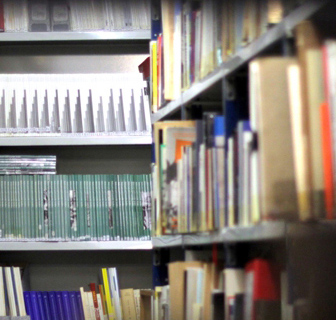
The Library
The Auschwitz Foundation makes a multilingual library with over 15,000 books available to the general public. The books and periodicals relate to the study of the Second World War (particularly in Belgium, France and the Netherlands), Fascism, National Socialism and the Third Reich (history, movements, regimes, institutions, society, economy, ideologies, etc.) as well as to all dimensions of Fascist and Nazi criminality (political repression, racial persecutions, medical experiments, war crimes, genocidal politics, etc.). The genocides of the Jews and Roma perpetrated by the Nazis are widely represented.
We possess extensive documentation on extermination centres and concentration camps.
Many books also deal with the history of anti-fascism, anti-Nazism and the Resistance in Europe.
More theoretical and methodological themes are also covered: the relationship between history and memory, the use of testimonies and oral history, the validity of comparative approaches, the great historiographical debates and controversies on the interpretation of totalitarian, fascist, Nazi and Stalinist phenomena, etc.
In addition, the Auschwitz Foundation library offers readers educational books, numerous testimonies and significant novels about the Shoah.
The collections also include works on racism, anti-Semitism, xenophobia and their resurgence, and on Holocaust denial today.
Other mass crimes and genocides, from the Armenians to Rwanda to the former Yugoslavia, etc., are also found among the works in our collection.
A computerised catalogue of books and periodicals is available to readers and can be consulted on site.
By appointment, the scientific staff of Remembrance of Auschwitz are available to guide readers in their research.
The library is open to the public from Monday to Friday from 9.30 a.m. to 12.30 a.m. and from 1.30 p.m. to 4.30 p.m., only after making an appointment with the library manager, Mr Verschueren, by e-mail.
Registration is free and compulsory. Consultations are free of charge. Some of the documentation can be borrowed for a fortnight. A4 photocopies can be produced for €0.05.
Access to the library and its documentation is subject to general reading regulations.
The Archive Collections
Since its creation in 1980, the Auschwitz Foundation has undertaken to collect all types of archival documents relating to the Nazi concentration camp world and the situation of deportees and survivors. This collection of archives is motivated by the desire to preserve as many traces as possible, but it also aims to gather a large amount of documentation for scientific research or any type of educational process.
The archives are accessible from Monday to Friday from 9.30 a.m. to 12.30 a.m. and from 1.30 p.m. to 4.30 p.m., by appointment only with the archives manager, Ms Timperman by e-mail.
The Auschwitz Foundation has a number of archive collections, including:
- A photo library consisting, on the one hand, of photos relating to the activities of the Amicale d'Auschwitz and the Auschwitz Foundation (trips, seminars, etc.) and, on the other hand, of photographic prints relating to the Second World War (Belgium under occupation, the Third Reich, concentration camps and extermination centres, etc.); these are reproductions from the main museums or renowned study centres;
- the archives of the Amicale Belge des Ex-Prisonniers Politiques d’Auschwitz-Birkenau: current archives of the Amicale such as correspondence, activity programmes, minutes of meetings, organisation of events, etc.;
- the archives of the International Auschwitz Committee: publications, minutes, balance sheets, articles of association, correspondence with national committees, etc.;
- the Personal Papers of Victims of Nazi Crimes and Genocides collection: these include membership cards, identification cards, deportation cards, official acknowledgements, correspondence, certificates and declarations of incarceration, photographs, press cuttings, drawings, etc.; the latter collection is mainly made up of documents supplied by survivors following their audiovisual interviews.
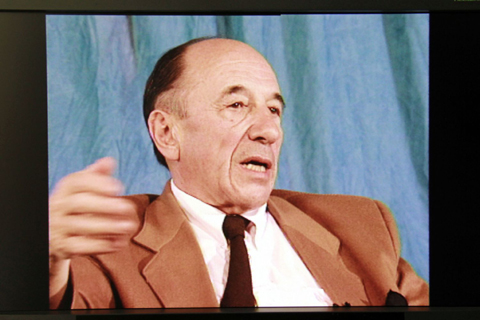
As the Belgian branch of the Fortunoff Video Archive for Holocaust Testimonies of Yale University, the Auschwitz Foundation has been collecting testimonies of camp survivors in the form of audiovisual interviews since 1992. These interviews are life stories in which the witness tells his or her story before, during and after deportation. The recordings are accompanied by a biographical sheet containing factual information about the witness’ life. In addition, a number of these interviews are thematically indexed (with reference to the ‘time-code’ and sequenced to facilitate research. To date, the Foundation has collected 246 interviews representing almost 1,250 interview hours. The average length of the interviews is 5 hours 10 minutes.
http://fortunoff-testimonies.be/
Contact
Auschwitz Foundation – Remembrance of Auschwitz
Rue aux Laines 17 box 50 – B-1000 Brussels +32 (0)2 512 79 98
 info@auschwitz.be
BCE/KBO Auschwitz Foundation: 0876787354
BCE/KBO Remembrance of Auschwitz: 0420667323
Office open from Monday to Friday 9:30am to 4:30pm.
Visit only by appointment.


Become a member
To become a member of Remembrance of Auschwitz ASBL, please contact us and transfer the sum of €50.00 to our account IBAN: BE55 3100 7805 1744 – BIC: BBRUBEBB with the communication: ‘Membership fee 2026’. The membership includes two issues of 2026 of our scientific journal.
DONATIONS
Donations of €40.00 or more (in one or more instalments) qualify for tax exemption for Belgian taxpayers.
In communication, please specify that it is a ‘Donation’ and mention your National Number which is required since 2024 to benefit from the tax exemption.
Subscribe
Error : Please select some lists in your AcyMailing module configuration for the field "Automatically subscribe to" and make sure the selected lists are enabled